by Noah J. Edmonds
An integrated 30-item tool for placing anyone – from Sunday-schoolers to secular biology majors – within the creation-evolution landscape.
Why the CE-BSI was developed
When it comes to the indexes that the Chardin Collective has developed so far, each focused on a single far-side of the origins question. The Young-Earth Creationism Belief-Strength Index (YEC-BSI) gauges someone’s commitment to a young-Earth worldview, while the Quick-Dialogue Evolution Acceptance and Rejection Index (QD-EARI) measures surface-level acceptance or rejection of evolution in general. As helpful as they are, neither tool can place a respondent reliably within the full landscape of positions on origins, from a fundamentalist six-day creation to a purely naturalistic evolutionary narrative.
Designing a bridge between the two ends therefore naturally became our next project. While previous work has been done identifying the existence of the creation-evolution continuum (Scott, 2004; 2016), no work has been done on developing a metric that can reliably show where people sit along it. Thus our goal was to build a scale that could (1) identify whether a participant is a Young-Earth Creationist (YEC), Old-Earth Creationist (OEC), Evolutionary Creationist (EC), Intelligent Design advocate (ID), or Naturalistic Evolutionist (NE), and (2) reveal which aspects of their thinking (age of the Earth, hermeneutics, confidence in science, etc.) drive that stance. The Creation-Evolution Belief Spectrum Index (CE-BSI) is the outcome of that effort.
A Brief Look at the Index
The CE-BSI is a 30-item questionnaire that takes roughly five minutes to complete. Each statement is answered on a five-point Likert scale (with half the items phrased to discourage “straight line” responding) and grouped into five, six-question domains:
| Domain | What it measures | Abbreviation |
|---|---|---|
| Chronology (#1-6) | Perceived age of Earth and universe | Chron. |
| Mechanism (#7-12) | Views on how biodiversity arose | Mech. |
| Agency (#13-18) | Degree/extent and timing of divine involvement | Agcy. |
| Hermeneutics (#19-24) | Fundamentalist vs symbolic reading of Genesis | Herm. |
| Epistemic Alignment (#25-30) | Confidence in mainstream science vs. revelatory authority | Epist. |
Note: “R” indicates a question which is intended to be “reverse scored” or subtracted from the total in each domain
- The Earth is less than 10,000 years old.
- Radiometric dating shows the Earth is billions of years old. (R)
- Most sedimentary rock layers were laid down in a single global Flood.
- The light we see from distant galaxies proves the universe is much older than a few thousand years. (R)
- Apparent age was built into creation from the start.
- Geological and astronomical evidence converge on an age of 4.5 billion years for the Earth. (R)
- All major “kinds” of life were created in their present form.
- Natural selection acting on genetic variation can explain the diversity of life. (R)
- Large-scale (“macro”) evolution has never been demonstrated.
- Common ancestry links all living organisms. (R)
- Biological information cannot arise without intelligent input.
- Evolution proceeds by natural processes that God set in motion but does not micromanage. (R)
- God actively guides each evolutionary step.
- Once life began, its development required no further supernatural input. (R)
- The design in nature points to an intelligent cause – whether inside or outside the natural order.
- Miraculous creation events ceased after the origin of life. (R)
- I see evidence of God’s direct creative acts throughout Earth’s history.
- Life developed by purely natural causes with no divine guidance at all. (R)
- Genesis 1 is a literal, historical account.
- Biblical creation narratives are theological poetry, not science. (R)
- Scripture overrides scientific conclusions when they appear to conflict.
- Ancient Near-Eastern literary genres inform my reading of Genesis. (R)
- A “day” in Genesis could represent a long, unspecified epoch. (R)
- Doctrinal truth in Genesis is independent of the scientific details. (R)
- Peer-reviewed science is my primary source for understanding origins. (R)
- Scientific consensus is biased against supernatural explanations.
- Multiple scientific disciplines independently support an old Earth. (R)
- I am skeptical of mainstream science when it contradicts my faith tradition.
- Dialogue between theology and science enriches our understanding of origins. (R)
- The best explanation wins, whether it is naturalistic or theistic. (R)
The scores for each of the five domains are summed on their own as separate sets, with the reverse-scored items from each domain subtracted from each domain’s sub-total, creating five sub-scores ranging from 6 (low endorsement) to 30 (strong endorsement). These scores can then be compared with a set of overlapping “cut windows”. (Table 2) If a respondent clears the thresholds for a single anchor by a comfortable margin, that anchor becomes their label. When several anchors are plausible, then Table 2’s estimates can be used to calculate how far inside each window the respondent sits, allowing the assessor to select the closest fit and attach a confidence value. Anyone who hovers on the border of multiple windows can simply be flagged Hybrid/Transitional, signaling that follow-up conversation might be necessary rather than forcing them into a label that doesn’t fit.
| Target anchor | Decision logic (≥ scores) | Notes |
|---|---|---|
| Young-Earth Creationist (YEC) | Chron ≥ 20 and Mech ≥ 20 and Herm ≥ 20 and Agcy ≥ 15 | High literalism & special creation; science-suspicious. |
| Old-Earth Creationist (OEC) | Chron 15-25 and Mech ≥ 20 and Herm ≥ 15 | Accepts deep time, likely rejects common ancestry. |
| Evolutionary Creationist (EC) | Mech 15-25 and Agcy ≥ 15 and Epist ≥ 15 and Chron ≥ 12 | Embraces evolution + providence. |
| Intelligent Design (ID) | Agcy ≥ 20 and Mech ≥ 15 and Chron > 12 and Herm ≥ 12 | Strong design detection; age and specific worldview are flexible. |
| Naturalistic Evolution (NE) | Agcy ≤ 10 and Mech ≤ 12 and Epist ≥ 18 | Naturalistic evolution; low scriptural authority. |
| Hybrid/Transitional | Does not meet any anchor; label “Blended/Transitional.” |
Simulations Testing the CE-BSI
To see how the index should behave before being refined as a legitimate research tool, we used an advanced-reasoning LLM (ChatGPT o3) to run a synthetic survey across 95 simulated participants whose religious affiliations follow U.S. polling data. Eight labels (Agnostic, Baptist, Catholic, Evangelical, Non-Religious/Atheist, Other Christian, Pentecostal/Charismatic, and Spiritual-but-not-Religious) were assigned in realistic proportions. (Brenan, 2024; PRC, 2014) Each participant also held a self-identified origins view (YEC, OEC, EC, ID, or NE) prior to taking the index.
| Anchor | Number of respondents | % of sample (n=95) | Median Chronology score (6-30) |
|---|---|---|---|
| Young-Earth Creationist (YEC) | 29 | 31 % | 23 |
| Old-Earth Creationist (OEC) | 17 | 18 % | 12 |
| Evolutionary Creationist (EC) | 11 | 12 % | 13 |
| Intelligent Design (ID) | 13 | 14 % | 14 |
| Naturalistic Evolutionist (NE) | 25 | 26 % | 12 |
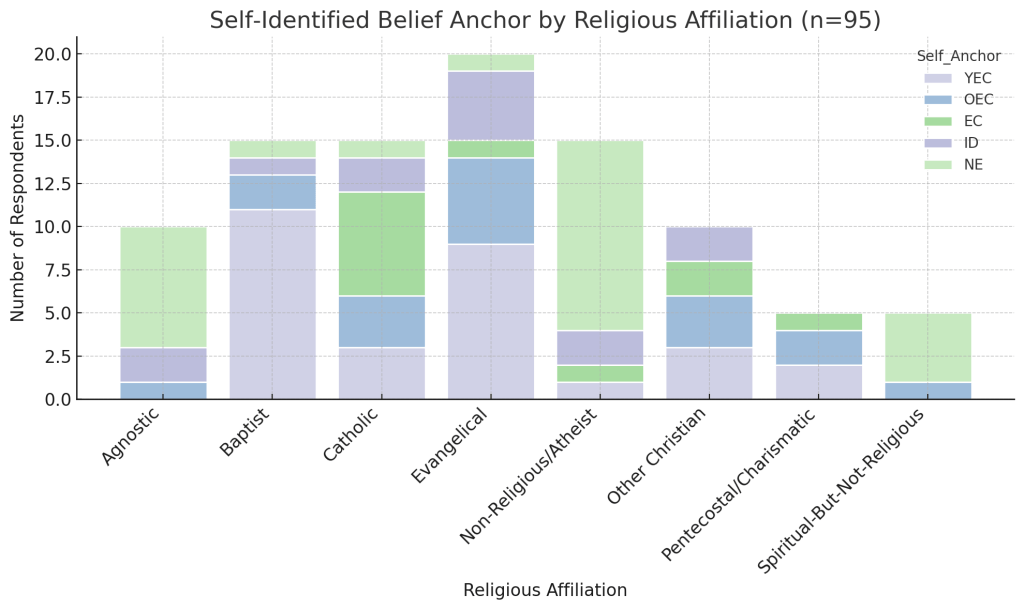
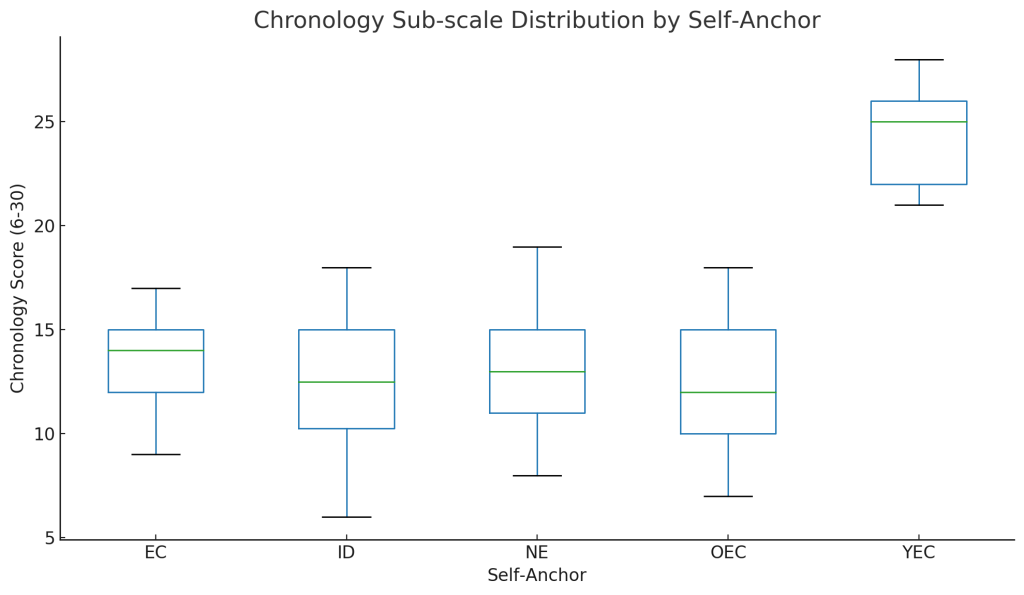
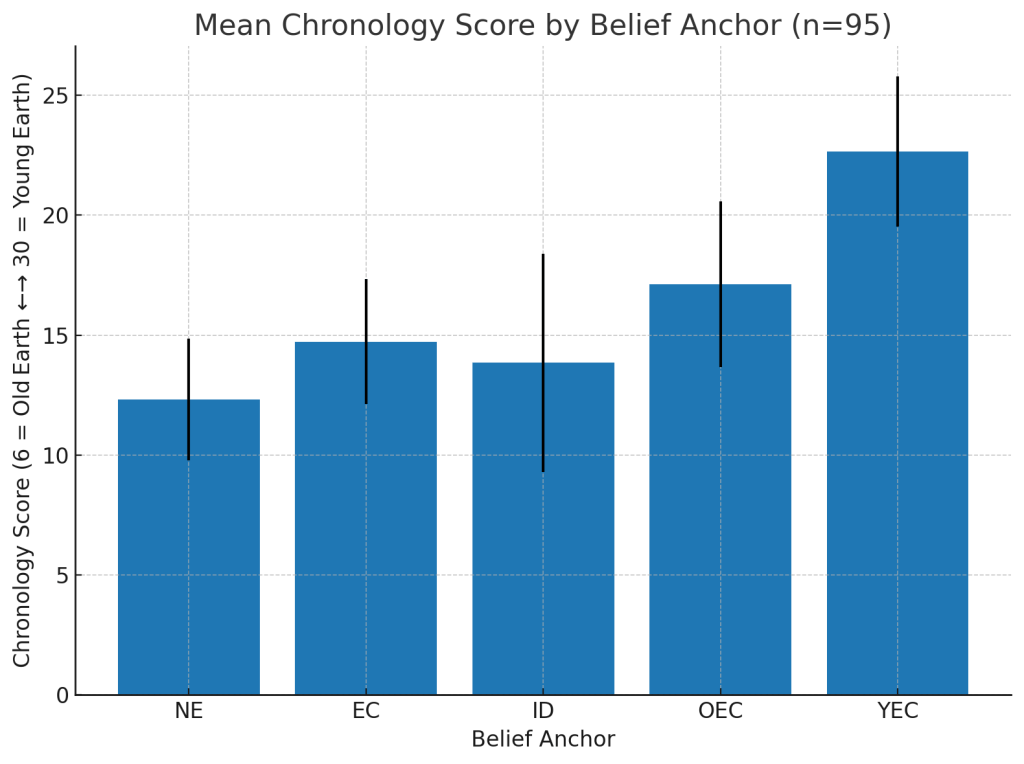
Fig. 1 reveals the expected clustering: Evangelicals lean heavily YEC/OEC, Catholics gravitate toward EC, and atheistis/agnostics stack up in the NE category. Each anchor category attracted double-digit counts, so the index avoided the “hybrid pile-up” problem that can plague broad-spectrum scales.1 Chronology behaved exactly as planned. In Fig. 2, mean age scores rise neatly from NE ≈ 12 through OEC ≈ 17 to YEC ≈ 23 (possible range 6-30). Non-overlapping medians confirm that the six age items separate young- and old-earth convictions without ceiling effects at the upper end. Internal consistency was strong for a pilot run: overall Cronbach’s α ≈ 0.88, with domain alphas between 0.78 (Epist.) and 0.85 (Mech.), suggesting that the wording is coherent without being redundant.
Some remaining-fine tuning issues were also observed that might be corrected by a future revision. A small subset of Catholic NE respondents scored in the mid-range on Agency, suggesting that the item wording (i.e., “purely natural causes”) may require sharper naturalistic/atheistic phrasing. Only 12% of respondents self-identified as ID, so outreach samples from groups such as the Discovery Institute or other ID-friendly organizations may allow for a larger and more robust calibration set.
While synthetic data cannot replace human participants, the simulation on the surface indicates that the CE-BSI tracks well-known patterns in origins narratives, cleanly separates young-and-old-Earth beliefs, and delivers reliability estimates suitable for exploratory work. The few issues noted arise from minor wording issues and sampling shortage, not structural flaws. In other words, the scale looks ready for real world pilots within settings where nuanced mapping of origin belief position would be valuable.
Further testing – Share your score in the comments!
This pilot is a proof-of-concept, not full validation. Real data from real people in real settings are still needed. So we invite you to try out the CE-BSI yourself, note your totals and anchor label using Table 2, and tell us how those results resonate (or clash) with your own perception of what you believe about origins.
If you’ve used the index in a church, school, or community setting, we’d love to hear how it went! Feel free to send a brief summary of the context and anonymized group results to us via our contact page. We hope to compile these anecdotal reports into a private case-study database to guide future revisions. Because we don’t have institutional oversight for human-subjects research, we’re not treating these contributions as publishable data – just informal feedback that helps us make the tool more useful and sensitive to real-world needs.
Footnotes
- In psychometrics this type of “hybrid pile-up” is known as central-tendency or “fence sitting” bias, which is flagged in the survey-methods literature as a downside of standard Likert formats despite their convenience, where respondents “sit on the fence” and cluster around the neutral option. This results in a swollen middle category that is hard to label cleanly. (Nikolaidis, 2025) A well known example of this is the original Measure of Acceptance of the Theory of Evolution (MATE). Researchers found that mid-range MATE scores were “multidimensional” with students choosing answers for reasons unrelated to simple acceptance of evolution, so moderate totals lumped together very different belief patterns. Those ambiguities in part prompted the development of the revised MATE 2.0. (Barnes et al., 2022)
REFERENCES
Barnes, M. E., Misheva, T., Supriya, K., Rutledge, M., Brownell, S. E. (2022) A Revised Measure of Acceptance of the Theory of Evolution: Introducing the MATE 2.0. CBE-Life Sciences Education, 21(1).
Brenan, M. (2024, July 22) Majority Still Credits God for Mankind, but Not Creationism. Gallup.
Nikolaidis, N. (2025, August 7) What is a Likert scale and how should you use it in surveys? Attest.
Pew Research Center (2014, February 3) Religious Groups’ Views on Evolution.
Scott, E. C. (2016, January 22) The Creation/Evolution Continuum. The National Center for Science Education.
Scott, E. C. (2004) The creation-evolution continuum: how to avoid classroom conflicts. Skeptic, 10(4).


Leave a Reply