by Noah J. Edmonds
A 12-item, two-minute gauge for classrooms, pulpits, and round-table dialogues.
Why the QD-EARI was developed
Our previously published index, the Young-Earth Creationism Belief-Strength Index (YEC-BSI), distilled key beliefs related to young-Earth creationism into 25 statements across three concise categories – Core Beliefs, Consistency, and Openness – so that educators and faith leaders could see, at a glance, how firmly someone embraces YEC ideas. (Edmonds, 2025) But when the conversation turns from young-Earth creationism to evolutionary belief, educators could benefit from the opposite: a brief, non-technical way to gauge where people sit on the acceptance and rejection spectrum of evolutionary topics, without handing out a six-page research instrument. Enter the Quick-Dialogue Evolution Acceptance and Rejection Index (QD-EARI).
Among the most cited instruments in the academic literature regarding the acceptance and rejection of evolution, the Measure of Acceptance of the Theory of Evolution (MATE) and its 2.0 revision remain the psychometric gold standard, boasting a unidimensional Rasch-validated scale and Cronbach alpha often above 0.90. (Barnes et al., 2022) However, its 20+ declarative items assume moderate content knowledge and take 6-10 minutes to administer. The Inventory for Student Evolution Acceptance (I-SEA) improves dimensionality, separating micro-, macro-, and human evolution, with good McDonald’s omega coefficients, but cognitive-interview studies show respondents frequently answer in a way that conflates knowledge about and acceptance of evolution. (Misheva et al., 2023) Additionally, the briefer Generalized Acceptance of Evolution Evaluation (GAENE) sacrifices depth for speed (8 items) and factor structure, but leads to “evolution” being interpreted differently by different respondents, and partially measures willingness to advocate for evolution rather than acceptance per se, resulting in inconsistent measurements. (Misheva et al., 2023)
As such, the index we’ve developed sought to account for these issues while being intentionally optimized for real-time YEC-evolution dialogues in classrooms, lecture halls, faculty workshops, and congregational settings: its 12 items retain three theoretically distinct domains (Core Acceptance, Consistency, Openness) and cover acceptance of mainstream science, human ancestry, theological/worldview compatibility, pedagogical willingness and openness to dialogue, yet stay within a two minute completion window, use lay language that lowers psychological threat, and include built-in worldview-compatibility statements that traditional research scales can omit. The stripped-down index sacrifices a bit of psychometric granularity to gain efficiency, psychological safety , and instant practical value – precisely what front-line educators and faith leaders need when conversations about young-Earth creationism and evolution get underway (a printable/downloadable index is provided at the end of this article).
- Observable genetic changes in bacteria and insects demonstrate evolution happening today.
- Radiometric dating shows Earth to be billions of years old.
- Humans and chimpanzees share a common ancestor.
- The fossil record documents transitions from fish to land-dwelling animals.
- My confidence in evolution remains even when scientists debate details.
- New discoveries in biology usually strengthen, not weaken, the evolutionary explanation of life.
- Understanding natural selection deepens my sense of wonder at life’s diversity.
- Accepting evolution does not diminish the meaning or dignity of human life.
- Evolutionary theory conflicts with my deepest convictions.
- I avoid books or videos that promote evolution.
- If evolution were true, morality would lose its foundation.
- I have no interest in evidence that supports evolution.
| Score | Outcome |
| 12-26 | Strong rejection of evolution |
| 27-38 | Mixed/unsure view of evolution |
| 39-49 | Moderate acceptance of evolution |
| 50-60 | Strong acceptance of evolution |
Simulations testing the QD-EARI
Similar to our pre-research test of the YEC-BSI, we used an advanced-reasoning LLM (ChatGPT o3) to record a synthetic survey of 95 simulated individuals to test the usefulness of our new evolution acceptance/rejection index. The scoring logic mirrors our previous work, with the twelve items following a Likert-style scale (i.e., 1=Strongly Disagree, 2=Disagree, 3=Neutral, 4=Agree, 5=Strongly Agree) with the scores from questions 1-8 added and the scores from 9-12 reverse scored and subtracted from the total. We left the model open options for specifying an underlying attitude distribution to reduce likelihood of bias in the simulated respondents and received a wide spread of total scores (range 14-60, a median ≈ 37, and a standard deviation ≈ 11.7).
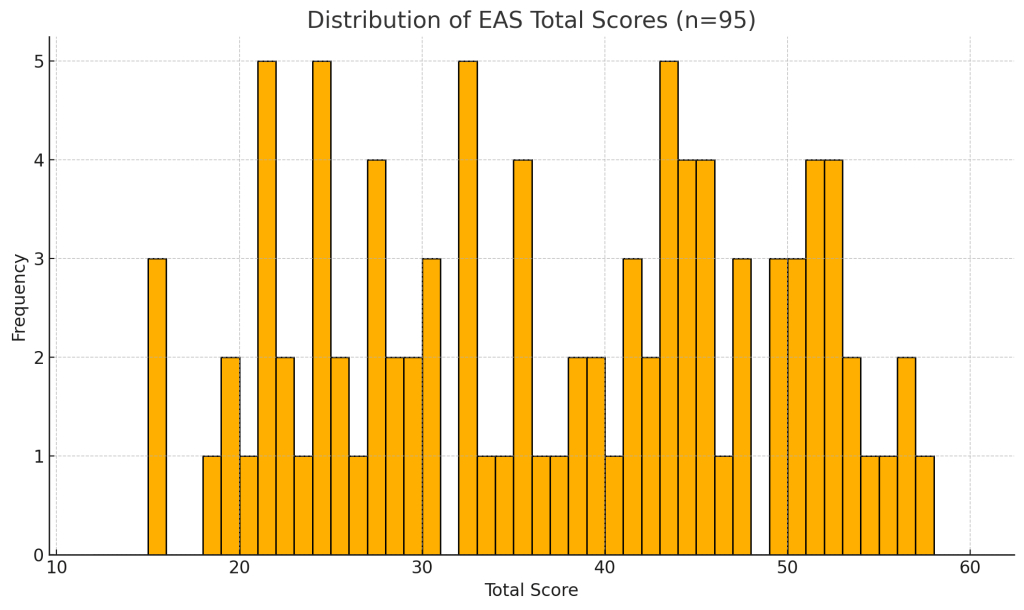
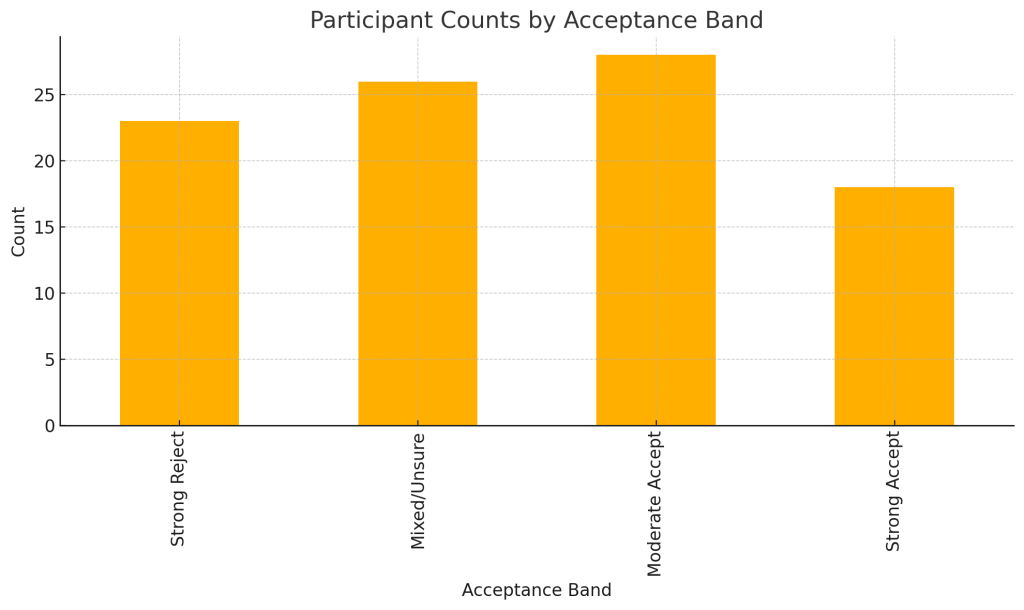
Roughly 25% of participants landed in each interpretation band (23 strong rejecters, 27 mixed/unsure, 24 moderate accepters, 21 strong accepters), confirming that the index can discriminate cleanly across the whole continuum without floor or ceiling effects. Fig. 1 shows four distinct peaks that align with the band cut-offs, while Fig. 2 illustrates near-even group sizes. Sub-scale means climb monotonically from Core ≈ 9 and Openness ≈ 8 among strong rejecters to Core ≈ 18 and Openness ≈ 18 among strong accepters, demonstrating internal consistency with the instrument’s theoretical structure. Internal consistency reliability for the scale reached Cronbrach alpha ≈ 0.90, only a hair below the 20-item MATE’s typical 0.91-0.93, yet takes one-third the time to administer. Sub-scale alphas were solid as well (Core ≈ 0.77, Consistency ≈ 0.78, Openness ≈ 0.66), and their means rose monotonically from the Strong-Reject group (≈ 7.5) to the Strong-Accept group (≈ 17.8), yielding an instant “heat map” of where evidential versus worldview barriers live. In short, the simulation confirms that the QD-EARI retains enough statistical resolution to guide constructive classroom or congregational dialogue, while its brevity, lay wording, and built-in worldview items make it far more practical and less threatening than heavier research instruments like MATE, I-SEA, or GAENE for the real-time YEC–evolution settings it was designed to serve.
In practice, these results imply that even a quick two-minute administration will yield actionable insights: facilitators can spot whether a class or congregation clusters at the evidential end (low Core, high Conflict) or the worldview end (low Openness) and tailor the ensuing dialogue accordingly.
Further testing – Share your scores in the comments!
The simulated survey we ran is strictly a proof-of-concept, not a validation study. While the QD-EARI shows promising results in silico, a sample of synthetic respondents is nowhere near adequate for establishing the index’s reliability or validity across diverse populations. For now, we see the QD-EARI as a conversation catalyst, perfect for congregations, classrooms, faculty retreats, youth-groups or workshops, but not as a fully vetted research tool.
You can help us refine the index by taking it yourself and dropping your total score (along with your denomination/tradition, score, and comments/feedback) in the comments below. If you’ve used the index in a church, school, or community setting, we’d love to hear how it went! Feel free to send a brief summary of the context and anonymized group results to us via our contact page. We hope to compile these anecdotal reports into a private case-study database to guide future revisions. Because we don’t have institutional oversight for human-subjects research, we’re not treating these contributions as publishable data – just informal feedback that helps us make the tool more useful and sensitive to real-world needs.
REFERENCES
Barnes, M. E., Misheva, T., Supriya, K., Rutledge, M., Brownell, S. E. (2022) A Revised Measure of Acceptance of the Theory of Evolution: Introducing the MATE 2.0. CBE-Life Sciences Education, 21(1).
Edmonds, N. J. (2025) Developing a Young-Earth Creationism Belief-Strength Index (YEC-BSI). The Chardin Collective.
Misheva, T., Brownell, S. E., Barnes, M. E. (2023) “It’s More Of A Me-Thing Than An Evolution Thing”: Exploring The Validity of Evolution Acceptance Measures Using Student Interviews. CBE-Life Sciences Education, 22(4).
 The Chardin Collective
Leave a comment