by Noah J. Edmonds
Intended for teachers, pastors, and curious readers to gauge where they and others stand on young-Earth creationism.
What is young-Earth creationism (YEC)?
Young-Earth creationism is the view that God created the entire universe, the Earth, and every kind of life in six ordinary, twenty-four-hour days only a few thousand years ago. It also (usually) holds that a global flood reshaped the Earth’s surface and that all living “kinds” were created separately, not through evolutionary processes. Millions of people, especially in conservative Evangelical circles, accept some version of this idea. (Brenan, 2024; Martin, 2010; Pew Research Center, 2014)
Why bother measuring YEC belief-strength?
If you teach science or Bible studies, or just want interesting conversations at family dinners, it can help to know how firmly someone holds YEC views. A casual “Maybe” calls for a different approach than a passionate “Absolutely!” Yet, until now, no one has put together a quick, user-friendly tool to measure that conviction – which is exactly why we developed the Young-Earth Creationism Belief Strength Index (YEC-BSI).
A Brief Description of the Index
We combed through twelve classic and popular YEC books (Ham, 2006, 2008, 2010, 2013; Ham & Hodge, 2013; ICR, 2013; Morris, 1985, 2000; Morris, 2007, Morris III, 2012; Morris III et al., 2020; Petersen, 2012) and condensed their central descriptions of young-Earth creationism down into three primary categories: ten questions on Core Beliefs (the basics, a young Earth, six-day creation, global flood, etc.), ten on Consistency (do the beliefs stay firm when challenged?), and five on Openness (willingness to consider mainstream/non-YEC opinions).
The index is scored on a simple five-point Likert scale. For each statement, rate whether you “strongly disagree” (1) or “strongly agree” (5) with the statement provided. Scores range from 0-125 – add up the total score of all your answers while reverse scoring (subtracting) the Openness items (a printable/downloadable index is provided at the end of this article).
- The Earth is less than 10,000 years old.
- The Genesis creation account is a literal, historical record of the material creation of the world.
- Dinosaurs and humans coexisted at the same time.
- Noah’s Flood was a global event that shaped the geological record.
- All animals were created according to their kinds by God de novo, and no new kinds have emerged.
- The theory of evolution is fundamentally flawed and incompatible with a Biblical worldview.
- The age of the Earth as determined by scientific methods such as radiometric dating is incorrect.
- The Grand Canyon likely formed by the receding waters of Noah’s Flood.
- Human beings were created in God’s image and do not have non-human ancestors.
- The Genesis creation account provides all the necessary information to understand the origins of the universe.
- I believe that all scientific evidence must be interpreted through the lens of Scripture.
- When I encounter scientific evidence that contradicts young-Earth creationism, I seek explanations that align with my beliefs.
- I trust that religious authorities are more reliable than scientific experts when it comes to understanding the Earth’s origins.
- I often find that scientific explanations for the origin of life are incompatible with my religious beliefs.
- I am confident that future scientific discoveries will continue to support a young-Earth perspective.
- I prefer to read books and articles that support young-Earth creationism rather than those that challenge it.
- When discussing the origins of the Earth, I prioritize Biblical teaching over scientific explanations.
- I believe that my faith provides all the necessary answers to questions about the origin of life.
- I often discuss young-Earth creationist beliefs with others who share the same views.
- I avoid engaging with media or education that promotes evolutionary theory.
- I am open to the possibility that the Earth could be older than 6,000-12,000 years old.
- I am willing to consider scientific evidence that supports the theory of evolution.
- I believe it is possible to reconcile a belief in God with the acceptance of an old Earth.
- I think it is important to critically evaluate both young-Earth creationist and evolutionary theories.
- I am interested in understanding why people believe in evolutionary theory, even if I don’t agree with it.
| Score | Outcome |
| 0-30 | Not a YEC |
| 31-60 | “On-the-fence”/Agnostic |
| 61-90 | Solid YEC |
| 91-125 | Committed, all-in, “no-compromise” YEC |
Simulations testing the YEC-BSI
Before publishing the index for use in real-world classrooms, we stress-tested it with a large batch of LLM-simulated responses (ChatGPT o3, n=95). Our goal was only to be sure that every statement “behaved”, that scores spread across the whole scale, and that the three mini-scales (Core Beliefs, Consistency, and reverse-scored Openness) marched in step as one construct. The respondents covered ages 18-70, four education levels (high school through graduate school) and nine primary faith-identifiers that mirror real U.S. survey categories from Baptists and Evangelicals to Mainline Protestants, Catholics, agnostics, atheists, and the “spiritual-but-not-religious” types. Each virtual participant carried a latent YEC-commitment score tuned to decades of polling: conservative Protestants start high, Catholics and Mainliners hover in middle to low, and non-religious groups anchor the low end. (Brenan, 2024; PRC, 2014) The latent signal drove answers on the 25 Likert items with a dash of randomness to mimic human noise.
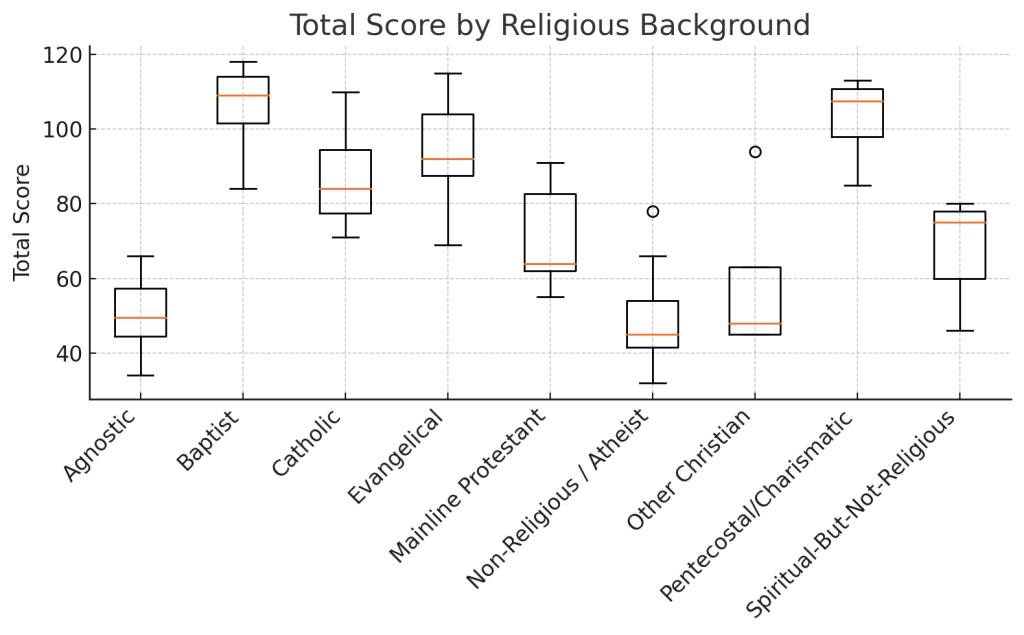
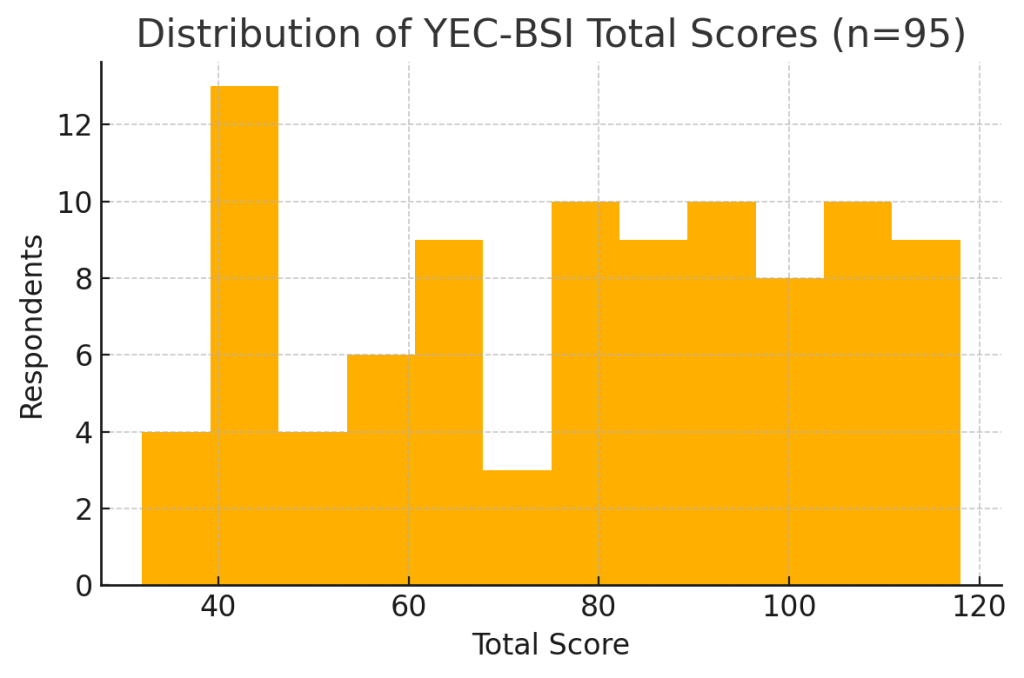
The 25 items hang together with a Cronbach’s alpha of 0.94, well inside the “excellent” band for a brand-new instrument and strong evidence that the index is tapping a single trait. Correlations between the three ten-item/ten-item/five-item sections ranged from r ≈ 0.85 to 0.89, confirming they rise and fall together. Total scores ranged from 33 to 119. The breaks observed in Fig. 1 produce the denominational pattern one would expect from Gallup (Brenan, 2024) and Pew Studies (2014): roughly seven in ten Baptists and two-thirds of Pentecostals fall in the “all-in” tier, while agnostics, atheists, and most Mainline Protestants concentrate in “fence-sitter” or Non-YEC territory. Catholics cluster around the mid-to-upper 70s, echoing previous findings that Catholic laity are relatively open to old-Earth timelines even when they affirm Biblical authority. Fig. 2 shows a healthy multimodal shape with no floor or ceiling pile-ups, so the scale can register movement in either direction once real-life interventions come into play.
Further testing – Share your scores in the comments!
A simulated run is an efficient check for general use, but it is not human validation. The real reliability will come from college course instructors, churches, and workshops/co-ops that use the index and report their results. The index is free to download and use, and you can share your score (along with your denomination/tradition, personal views on the age of the Earth, and any questions/comments/feedback) in the comments below.
If you’ve used the index in a church, school, or community setting, we’d love to hear how it went! Feel free to send a brief summary of the context and anonymized group results to us via our contact page. We hope to compile these anecdotal reports into a private case-study database to guide future revisions. Because we don’t have institutional oversight for human-subjects research, we’re not treating these contributions as publishable data – just informal feedback that helps us make the tool more useful and sensitive to real-world needs.1
Footnotes
- One of the reasons we’re actively pursuing real-world verification of the index is that in a preliminary survey we ran on 4o before the o3 one mentioned in this article, a high percentage of the simulated respondents chose neutral options and created a balanced distribution around moderate scores, particularly in the openness section, possibly indicating a sample that was somewhat hesitant to take strong stances. This could have been a decision on the LLM’s part to factor in social desirability or an inherent cautiousness in expressing strong opinions on controversial topics, traits often associated with agreeableness. Agreeable individuals tend to prefer harmony and may avoid strong disagreements or taking firm stances that would be seen as confrontational. (Wilmont & Ones, 2022) However, in our second survey (o3), the five openness items didn’t cluster around the neutral point they did in the first survey. The neutral option never drew a majority (the highest was one-third of respondents on Q23 and Q25) and extremes showed up just as often, sometimes more often, than neutrals, indicating that many virtual participants were willing to plant a firm flag. Means hovered between 2.7 and 3.0, and standard deviations hovered around 1.15-1.23, suggesting a healthy spread as opposed to a tight knot around the midpoint. Despite this, openness to alternative perspectives tracked inversely with total YEC commitment (≈ ‑0.85), retaining a reason for analyzing real-world responses while co-administering OCEAN/The Big Five to measure respondents’ self-reported temperaments to test if there are any correlations between personality type and YEC belief strength.
REFERENCES
Brenan, M. (2024, July 22) Majority Still Credits God for Mankind, but Not Creationism. Gallup.
Ham, K. (Ed.) (2006) The New Answers Book 1: Over 25 Questions on Creation/Evolution and the Bible. Answers in Genesis.
Ham, K. (Ed.) (2008) The New Answers Book 2: Over 30 Questions on Creation/Evolution and the Bible. Answers in Genesis.
Ham, K. (Ed.) (2010) The New Answers Book 3: Over 35 Questions on Creation/Evolution and the Bible. Master Books.
Ham, K. (Ed.) (2013) The New Answers Book 4: Over 30 Questions on Creation/Evolution and the Bible. Master Books.
Ham, K. & Hodge, B. (2016) A Flood of Evidence: 40 Reasons Noah and the Ark Still Matter. Master Books.
Institute for Creation Research (2013) Guide to Creation Basics.
Martin, J. W. (2010) Compatibility of Major U.S. Christian Denominations with Evolution. Evolution: Education and Outreach, 3, 420-431.
Morris, H. M. (2000) Biblical Creationism: What Each Book of the Bible Teaches About Creation and the Flood. New Leaf Publishing.
Morris, H. M. (1985) Scientific Creationism. New Leaf Publishing.
Morris, J. (2007) The Young Earth: The Real History of the Earth – Past, Present, and Future. Master Books.
Morris III, H., Morris, J. D., Guliuzza, R. J., Tomkins, J. P., Cupps, V. R., Thomas, B., Clarey, T., Hebert, J., Sherwin, F., Johnson, J. J. S. (2020) Creation Basics and Beyond (2nd Edition): An In-Depth Look at Science, Origins, and Evolution. Institute for Creation Research.
Morris III, H. (2012) Exploring the Evidence for Creation: Reasons to Believe the Biblical Account. Harvest House Publishers.
Petersen, D. R. (2012) Unlocking the Mysteries of Creation (2nd Edition). Creation Resource Publications.
Pew Research Center (2014, February 3) Religious Groups’ Views on Evolution.
Wilmont, M. P. & Ones, D. S. (2022) Agreeableness and its Consequences: A Quantitative Review of Meta-Analytic Findings. Academy of Management Proceedings, 1.
 The Chardin Collective
Leave a comment